School of Canon Law


The School of Canon Law strives to prepare canonists with a deep theoretical and practical knowledge of Church law, which helps them develop legal skills with pastoral sensibility, while meeting the practical demands of legal praxis among God's people.

English brochure


Teaching follows a systematic method. It attempts to integrate the many juridical institutions emerging from the study of the Church’s Law within the diverse branches of canonical science. All this, in conformity with the Church’s vision of herself as expressed in the Second Vatican Council.

The program’s realist perspective helps the student to appreciate the dimension of justice that belongs to the salvific goods of the Church even prior to their reception in positive law.  This metaphysical realism offers a much richer viewpoint than the old positivistic outlook, which still influences some currents of canonical thought.  Students learn to seek justice while exercising legal prudence in fidelity to sound ecclesiastical tradition.
The program integrates theoretical study with courses on legal praxis.

The School has a large number of permanent professors as well as many prestigious visiting professors from the Roman Curia and from all over the world.

The School’s research and teaching are enriched by the staff’s experience in various dicasteries of the Holy See and in the Tribunals of the Vicariate of Rome. Close links to and regular academic collaboration with colleagues from other universities of Rome and of other countries also enrich the School, along with the theological research and collaboration of the School of Theology.


Sezione: 
In evidenza

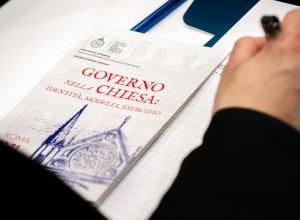
On April 20 and 21, 2026 (9:00 a.m., John Paul II Aula Magna), a conference will be held on the theme of governance in the Church—an especially timely reflection in light of recent ecclesial developments that have brought both longstanding and new questions regarding the exercise of authority and power back to the forefront.

The event aims to explore several fundamental issues: What does it mean to govern in the Church? What are the foundations of the exercise of ecclesial power? To what extent are models of governance offered by history, both within and outside the Church, effective or applicable in the context of contemporary challenges?

The Ninth Renewal Course of Marriage Law and Canonical Procedure will be held in Rome from September 21 to 25, 2026.
This edition of the course aims primarily to inform ministers and professionals in ecclesiastical courts worldwide about the major regulatory, doctrinal, and jurisprudential developments that have emerged during the first ten years of application of the 2015 Motu Proprio Mitis Iudex Dominus Iesus and Mitis et Misericors Iesus. Other relevant issues pertaining to the work of ecclesiastical courts will also be studied.
The methodology followed is both theoretical and practical, aiming to combine a scholarly presentation of new canonical developments and matrimonial proceedings—which often present challenges in ecclesiastical courts—with the identification, examination, and discussion of practical cases previously submitted to all participants.

The main dates of the 2026/2027 Academic Calendar for the Schools and the ISSR at Apollinare are announced.

From Thursday 3 to Wednesday 30 September 2026
Italian course for new students

5 October 2026
Opening of the academic year

6 October 2026
Start of classes (1st semester)

7 October 2026
Welcome Day for new students

From 16 February to 18 May 2026, every Monday from 3:00 p.m. to 4:40 p.m., the Schools of Communication, Theology, and Canon Law are organizing the optional course (2 ECTS) Welcoming Victims of Abuse in the Church.

The subject is structured into four modules, corresponding to different perspectives: abuse, trauma, and prevention; accompaniment of victims; the legal framework; and communication aspects.

Pages

Follow the university's activities

Newsletter - L'Appuntamento

Stay up to date on our activities and events

Subscribe